
The Town of Ricigliano – Province of Salerno, Italy
The town of Ricigliano has a very remote origin which dates back to 1320 B.C.
This town was the first built and inhabited by the Greeks who came from Peloponnesus to settle in ancient Lucania.
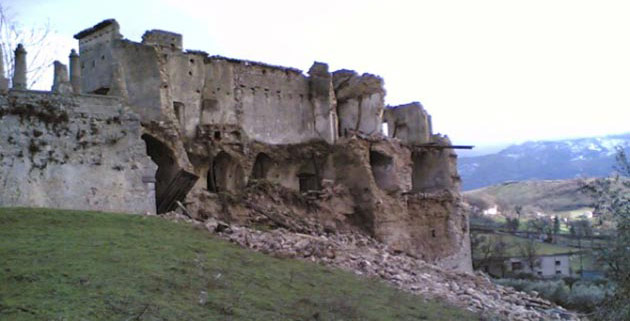
Janus, the two face Greek mythological deity, who became the supreme god of the Etruscans and subsequently was recognized by the Romans as their god of doorway and gateways, had his abode in the high massive turreted castle of Ricigliano. This castle dominated the whole country side and even today the foundations can be clearly seen.
After the decline of the Greek power in Italy and the later subjugation of the Etruscans by Rome, Ricigliano was elected a Roman Colony and later came under the rule of King Alaric the Gothic conqueror of Rome.
Originally Ricigliano consisted of six distinct and separate hamlets of villages, namely, Sant’Elia, Sant’Iorio. Sant’Ianni, San Giorgio, San Pietro and Santa Zaccaria, traces of which can yet be seen.
The Coat of Arms of Ricigliano reveals authentically its origin and history; it has on top the two bearded face of Janus; in the center is the sun that rises to bless the lands and below are the cattle, bundles of grain, olive trees and underneath the sun is the horn of abundance all symbolic of a rich agricultural land.
The following was condensed and translated into English by Rev. Raphael Pazzelli – Newark, New Jersey
Ricigliano: Description
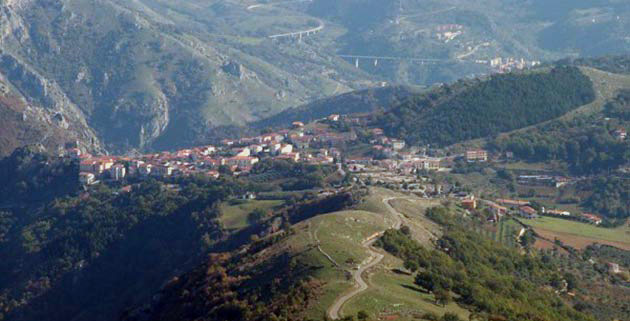
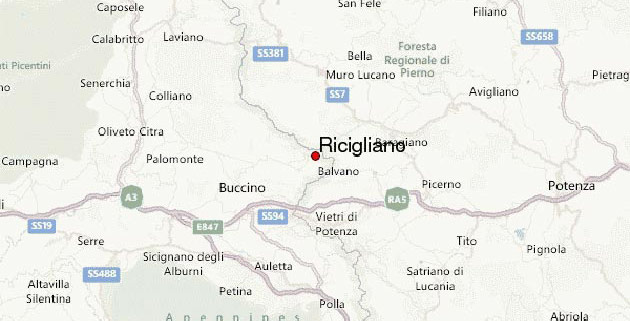
The town of Ricigliano, in the province of Salerno (Italy), is situated at the border with Basilicata. It is part of the Diocese of Muro and the civil department of Buccino. Ricigliano is 510 mt. above sea level and has 1,488 inhabitants (Census of 1950). Its territory is 2828 hectares, equal to 6,984 acres; it is crossed by a “provincial road” which connects it to all principal towns toward Salerno to one side, and toward Potenza, Taranto and Brindisi to the other. It is served by its railway station (Balvano-Ricigliano) though 5 kilometers away from the town, on the Salerno-Potenza line. It has its own City Hall, post office, telegraph, telephone and holds its annual Fair on July 23 and 24. It is provided with electricity and its own pipe-line supplying drinking water. As it looks now, Ricigliano is clearly composed of two principal parts; the ancient and the recent town. The ancient Ricigliano is easily identified by the old agglomarate – once encircled with towers and walls – with cliffs and slopes beneath the inaccessible rock toward the river Platano and formed by the ruined castle and houses surrounding it, as well as by the very narrow streets Torretta and Castello which lead to the “Piazza di Dentro” through the only door or gateway called of St. Cristoforo. The recent Ricigliano, built outside the walls during the thirteenth and fourteenth centuries, is formed by the sections St. Nicola, Annunziata, Serra, Sopra la Serra, St. Sebastiano and Ariola.
History
The origins of Ricigliano go back to an era before the time of the Roman Empire, of which it became then a colony, namely to the period of the first coming of the Greeks to the land of Lucania (S. Italy). Ricigliano – so runs the publication “Historical memories of the city of Sorrento”, written by the noble man Vincenzo Donnorso in 1870 – was built by the Greeks, when the first came and lived in Lucania. During the time of the Roman Empire it was erected into a colony. After the falling of the Roman Empire it was destroyed by Alaricus, the king of the Goths. Its lands are very fertile and producing all kinds of grains. It has fields, vegetable gardens, good housing and deep cellars where wine is kept cool in summertime. It doesn’t lack for hunting, especially game, and there are even bears. In this description we can easily distinguish the two towns we are talking about, the original Ricigliano conquered and destroyed by Alaricus in the year 410 A.D., and the more recent one which was built later.
The Original Ricigliano
In the original Ricigliano the pagan religion was practiced, since Greeks and Romans were polyteists, that is believers in many gods. This is proven by the remains of a small temple still existing in Chiaio ( a section of the town) dedicated to the god Janus, and by a tomb found in Ordicuso (another section) and identical to that of Virgilius in Naples, and by coins of Caesars, etruscan vases and breast plates found in graves along roads and the nearby countryside. A furtherr corroboration for this is given by the Latin etymology of the name Ricigliano which means “recinctum Jani” that is a place sacred to the god Janus; the same thing is proved by the ancient as well as the present armorial bearings of the town which carries, at the top on the right, the head of the bifront Janus and – on the shield – the sun over the horn of plenty, an olive tree, an oak tree, a fat ox, a ram and a goat on green plains, to indicate the agriculture and the pastoral industry.
The recent Ricigliano was started by the few survivors of the invasion and destruction of the old one: they at first built humble houses and later comfortable ones and chapels; finally in the year 1250 a small church dedicated to St. Peter the Apostle. All these constructions were encircled with walls and towers, the remains of which are still visible. There was only one door to the town and it was called of St. Cristoforo. Among the most ancient and important buildings, some of which are still existing, were the houses of the noble Sanseverinos, De Murano, Matone, Malavoglia (now Bonavoglia), Pacelli, Mangone, Galtieri, Pintozzi, Caponigri, Marra and others. The ancient houses of Sanseverino, De Murano and Matone, which later were purchased by Bonavoglia, in 1776 were connected with an overbridge, over Castello Street that divides them (the present Arco-del-Castello). The small town, so encircled, was crossed – as it is even now – by the streets Castello, La Savina (called at present Torella) and Malpertuso, with two small esplanades and Piazzadi Dentro.
The Recent Ricigliano
It is not easy to follow the history of the new Ricigliano since its beginning. We can say that very probably there was a clerical administration, as in many other small towns of Italy at the time, till the eleventh century when the citizens of Ricigliano succeeded in administering their town by themselves. The people used then to gather in the main square, as a Parliament, and voted their laws and elected their Chief, at first a Consul and later a Podesta, helped out by a Council made up by the most worthy citizens.
To this organization followed the “Decurionate” (a government of 10 men) and later the City Council, as it is at present, with the Sindaco who once was nominated by superior authority and today is elected by the people. We know that in the eighth century there was a notable increase of popularity, due to the greater security provided by the walls and towers; many families that used to live in the countryside and were frequently molested by robbers and strangers decided to move into town where in the year 1250 they built, as it has been said, the Church of St. Peter.
During the same period, the noble lady Catherine Sanseverino, who was married to Count D. Ruggero, built a Monastery dedicated to St. Catherine, giving to it a large estate. A part of this estate is known till now as Cerzota of St. Catherine. The Monastery was entrusted to the Dominican Fathers who later on built there a magnificent church with the main altar in local stone (scariazzo) and four more altars in marble, dedicated to St. Domenic, St. Vincent Perreri, St. Peter Martyr and to the Holy Rosary.
After the civil suppression of Religious Orders, which took place in 1803, transferred to the Bank of St. Gregory and later to Turturiello, Romanzi, Pascente, Galante, Pregnano and other famalies. The old artistic statue of St. Catherine and the four Paintings of the Altars – since the church was semi-abandoned and in danger of collapsing – in 1940 were taken out and kept in City Hall.
The Growing of the Town
Midway through the thirteenth century, since the inhabitants of Ricigliano who had increased in number as we said could hardly all live in a small wall-encircled town, many of them – led by their priests – started building new sections outside the walls, with a Chapel for each one of them. As a result, there came into existence the Chapels and sections of St. Vito, St. Nicola, St. Lucy, the Succor, Sts. Rocco and Sebastion and finally the main Church which took the name of the old in the castle, now too small for the people. To recall this event, centuries later the citizens of Ricigliano erected a cross in piperno marble in front of the gateway, in the center of the small square “Monte Oliveto” with an image of St. Christopher, the patron Saint, and the inscription of the year 1588.
Ricigliano and St. Gregorio
During the thirteenth century a new town came into existence near Ricigliano and it was named after the great Roman Pontiff Gregory VII. This town, St. Gregorio, grew in inhabitants and little by little conquered the surrounding territories; Ricigliano too had to suffer damages and usurpations. From the year 1477 on, there were many quarrels between the two towns about jurisdiction over some territories. These disputes were definitely solved only in 1875 when the territories of the two towns were clearly determined by a sentence of the “Corte di Appello” of Naples and Ricigliano had the present area of 2828 hectares.
Feudalism and Feudatories
From the year 1488 Ricigliano – as most of the towns of Italy – had its feudatories. The first one was Marino Dell’Amania who got the investiture from the King of Aragone Ferdinand on May 20 of that year. In 1545 his rights were transferred to Bernabo Caracciolo, then in 1568 to the Duke of Laviano and, finally, in the eighteenth century, to Michele De Marinis from Cava dai Tirreni. His heir, General Alberto De Marini, who after World War One represented Italy at the Council of Nations in Geneva, in 1933 gave way these rights to the towns of Ricigliano and St. Gregorio. The last family of feudatories, De Marinis, after the growing of the population, demolished walls and towers and built a big edifice in the main square: this building was inaugurated in 1733 and named “Palazzo del Barone.” Following the unification of Italy (1860), the building was purchased partly by the town and transformed in the present City Hall and partly by Pintozzi and Caponigri families.
At this time (eighteenth) century everyone was feverishly building and thus there came into existence the houses of De Leonardi (year 1740) now property of Mangone Gerardo; the houses of Mangone Raffaele (1740), of Pacelli Daniele (1765) now of Tracconese; of Bonavoglia Carlo (1763); of Pacelli Pascasio, now of Saggese and Galante; of Rev. Caponingri Pasquale, of Pacelli Gaetano (1775), now of his nephew Domenico; of Pacelli Pietro, now of Mangone Orazio; of Rev. Caponigri Gregorio, now of Bagnolo Vitovencenzo; of Pacelli Onofrio, now of Malpede Francesco; of Rev. Parrilli Vincenzo; of Galante Cesare; of Parrilli Carmine (Pisapolva) of Rev. Pintozzi Giuseppe, currently of Napolentano and Pintozzi Giuseppe, currently of Napolentano and Pintozzie Giuseppe Gerardo; of Bonavoglia Alessandro, now of Serritella Vito and Serra Michele.
In the new sections Annuziata, Serra and St. Nicola we may recall the houses of Maccia Gerardo, currently of Mangone Marietta; of Meccia Michele at present of Lizzadro Iaculio Cristina; and that of Rev. Freda Pasquale.
For most of these new buildings they reused materials taken from the demolished walls and towers of the town. The terrible earthquake of September 8, 1962 destroyed completely the castle, some chapels and many houses around the castle; likewise it damaged the steeple of the main Church. Most of the damaged private houses were quickly repaired, but it was not so for the old houses around the castle, nor for the chapels. These, after being abandoned, were later converted into private housing. The steeple of the Church was restored only in 1949 under the sponsorship of M.D. Nicola Pintozzi in memory of his father Domenico of the last Prospero.
It is well known that brigandism was an ancient plague in southern Italy, caused by dissentions among landowners and vexations of unscrupulous rulers, so that many people to escape the law, after breaking it, lived in the bush and from there used to come out and rob those who were rich and in a high position.
Things worsened around the year 1860 after the king of the two Sicilies, Francis 2nd, had fled to Rome and a revolution had broken out in Basilicata. All the criminals, the fighters of despotism and those who used to take advantage from confusion, or were looking for vengeance, broke loose at this time. Many towns had to suffer from this, and among them also Ricigliano. In the evening of November 23, 1861 a rumor was being circulated that a horde of brigands, under the guide of Boryes, Lanlois and Rocco, had entered the nearby town of Balvano and that its citzens had accepted them peacefully, to avoid what had happened a few days before to the town of Pietragalla and Bella, which had tried to fight them back and as consequence were set on fire and destroyed. This rumor caused young people and authorities to flee the town, towards Buzzino. The remaining people, mostly women and children, decided to receive the bandits with the palm and the cross, hoping to avoid, by that means, destruction or robbery. As a matter of fact, in the early afternoon of the next day, the clergy and people of Ricigliano went to meet them outside the town. But they were not so lucky. It is impossible to refer the sacking of all the houses of the wealthy families, the extortion of large sums of money, the robbery of silverware and other valuable things. It was real pillage of everything. A few days afterward that horde of bandits were defeated at Pescopagano and Bryers, one of the leaders, was killed near Tagliacozzo, while trying to escape into Papel States; his group split into 44 small gangs, each one of whom took the name of his respective new leader. These gangs kept on prowling around and the poor people of the country had to suffer any kind of trials, with depredations, rapes, woundings and assassinations.
Emigration
The brigandism was finally defeated around 1867 and Ricigliano enjoyed a period of freedom and peace. But there was unemployment and scarcity of crops; the poor people were living among privations and sacrifices, plagued by debts, usury and taxes. It was at this time that some families left Ricigliano and came to the United States of America. The very first families to do so were those of Turturello Onofrio (Zolla) and Parrilli Vito of the late Donato (Sordone). They happened to be lucky in the new country and very soon a remarkable movement of emigration was on the way so that within a few years the people of Ricigiliano were left to half the size of its previous numbers. While in the year 1870 in Ricigliano there were 2,300 inhabitants, in 1890 only 1,100 were left in the town.
The emigrants did not forget their own town and by the money they started sending to their relations they positively helped better conditions of life back home.